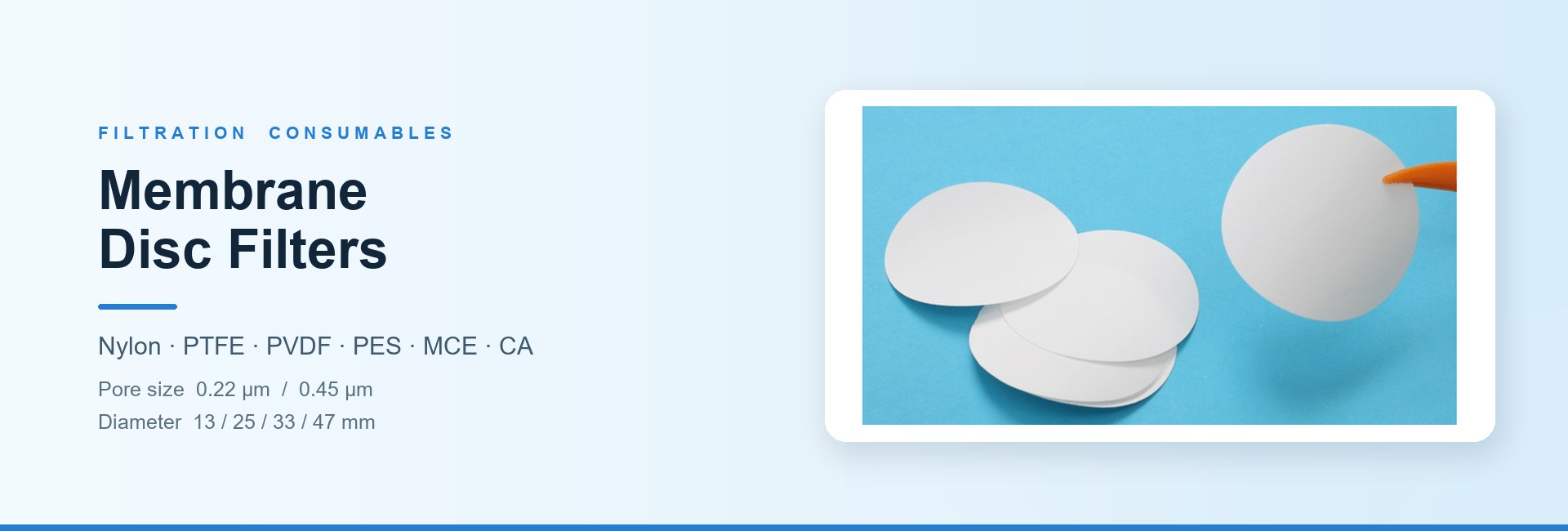
Membrane Disc Filters
Professional laboratory membrane disc filters with various materials (Nylon, PTFE, PVDF, PES) and pore sizes for precise chemical and biological filtration.
Discover our comprehensive range of high-performance membrane disc filters, engineered for reliable clarification, sterile filtration, and sample preparation in analytical laboratories.
How to choose a membrane disc filter
Disc filters are used where you need to filter a larger volume than a syringe filter can handle, or where the filter goes into a holder rather than onto a syringe. Four parameters decide the choice: diameter, pore size, membrane chemistry and support.
- Diameter — 13, 25, 47 and 50 mm. Must match the filter holder or funnel.
- Pore size — 0.22 µm for sterilisation and particle-free work; 0.45 µm for general clarification.
- Chemistry — must resist the solvent and not bind the analyte.
- Format — plain disc, or pre-sterilised and individually packed.
Membrane types compared
| Membrane | Property | Typical use |
|---|
| Nylon | Hydrophilic, good solvent resistance | Aqueous and organic mobile phases, general clarification |
| PTFE | Hydrophobic, chemically inert | Aggressive solvents, gas filtration, venting |
| PVDF | Low binding, hydrophobic or hydrophilic | Protein solutions, HPLC solvents |
| PES | Very low binding, high flow | Cell culture media, protein work |
| MCE | Hydrophilic, high binding | Aqueous clarification, sterile filtration |
| CA | Low binding, hydrophilic | Biological samples, low extractables |
| GF | Depth filter, high loading | Pre-filtration ahead of a membrane |
Diameter: matching the holder
The disc must sit flat in the holder with no overhang and no gap at the edge. A disc that is slightly too small lets unfiltered liquid bypass the membrane entirely — the filtration looks fine and is not happening.
- 13 mm — small holders, syringe adapters, low volume.
- 25 mm — the common analytical size.
- 47 mm — vacuum filtration, solvent preparation, microbiology.
- 50 mm — specific funnel systems; check the nominal diameter your holder accepts.
Filtration that actually works
- Pre-wet the membrane. A dry hydrophobic membrane will not pass aqueous liquid at all; wet it with a miscible solvent first.
- Filter by gravity or gentle vacuum. Pulling hard on a vacuum flask forces particulate through the pores and can rupture the membrane.
- Discard the first portion. The first few millilitres carry extractables and any loose fibre from the manufacturing process.
- Use a pre-filter for dirty samples. A glass fibre disc ahead of the membrane dramatically increases loading capacity.
Common problems and fixes
| Symptom | Likely cause | Fix |
|---|
| Filtration appears to do nothing | Disc diameter smaller than the holder seat | Match disc diameter to the holder exactly |
| Membrane ruptures under vacuum | Too much differential pressure | Reduce vacuum; use a supported membrane |
| No flow with aqueous sample | Hydrophobic membrane not pre-wet | Pre-wet with ethanol or IPA, then rinse |
| Analyte loss | Binding to a high-protein-binding membrane | Switch to PES, CA or RC |
| Ghost peaks in the chromatogram | Extractables from the membrane | Rinse with mobile phase; use a low-extractable grade |
Frequently asked questions
What is the difference between a disc filter and a syringe filter?
A disc is the bare membrane, used in a separate holder or funnel. A syringe filter is the same membrane pre-mounted in a plastic housing for direct attachment to a syringe.
Can I use a 47 mm disc in a 50 mm holder?
No. A disc smaller than the seat allows liquid to bypass the membrane around the edge. Match the nominal diameter to the holder.
Which membrane is best for HPLC solvent filtration?
Nylon or PVDF at 0.45 µm for aqueous and mixed phases; PTFE for pure organic solvents. Filter the mobile phase, not just the sample — particulate in the reservoir reaches the column.
Are disc filters reusable?
No. Discs are single-use. Cleaning and reusing a membrane changes its pore structure and invalidates any claim about retention.
Why does my aqueous sample not pass through a PTFE disc?
PTFE is hydrophobic. Pre-wet with a small volume of ethanol or isopropanol, then rinse with water before use, or specify a hydrophilic PTFE grade.

 English
 Chinese