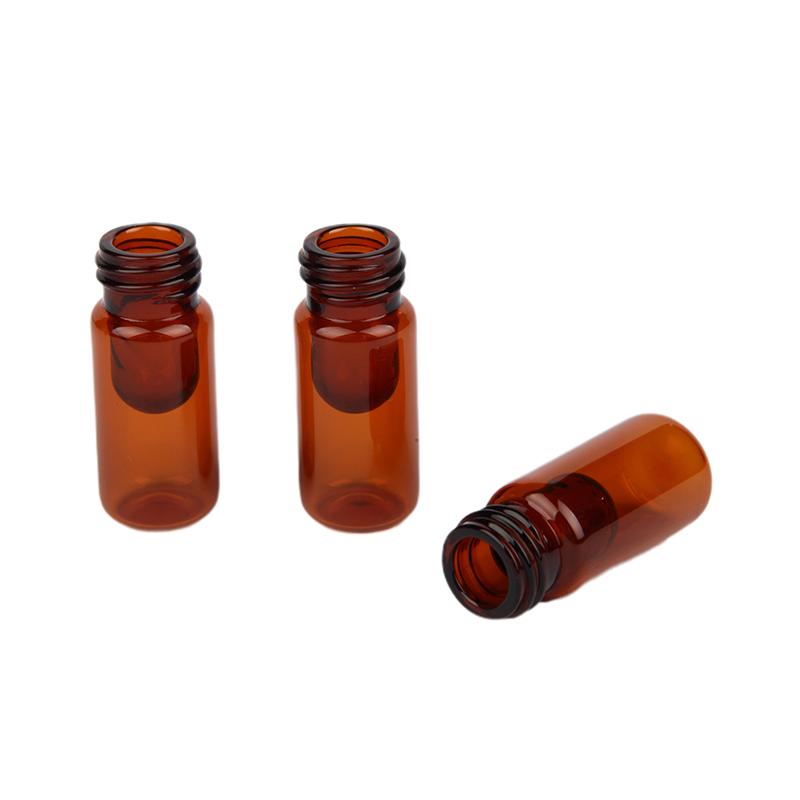
Micro Vials Series
Aijiren’s micro vials are designed for precision analytical laboratories that handle trace sample volumes. Made from high-quality borosilicate glass, these vials offer superior chemical resistance, minimal residue, and excellent sealing performance. With multiple configurations such as insert vials, high-recovery vials, and welded micro vials, the series supports reliable sample preparation, trace analysis, and chromatographic applications across food, pharmaceutical, chemical, and environmental testing industries.
How to choose a micro vial or insert
Micro vials and inserts exist for one reason: to let an autosampler reach a small volume of sample without losing it to the vial's dead volume. The choice comes down to how much sample you have, what the autosampler can reach, and whether the insert is separate or integrated.
- Volume — 150, 250 or 300 µL for inserts; 0.3–0.5 mL for micro vials.
- Bottom shape — conical recovers more; flat is easier for a needle that cannot reach a tip.
- Format — separate insert in a standard vial, or an integrated micro vial.
- Fit — the insert must match the vial's internal geometry, not just the thread.
Insert formats compared
| Format | Volume | Recovery | Notes |
|---|
| Conical insert | 150–300 µL | Highest | Sample collects in the tip; needs a needle that reaches it |
| Flat bottom insert | 150–300 µL | Lower | For autosamplers with limited needle travel |
| Integrated micro vial | 0.3–0.5 mL | High | Insert moulded into the vial; no separate part to misalign |
| Shell vial | 1 mL | Standard | Wide mouth, for 8 mm plug or crimp closure |
| Polymers (PP) | 0.3 mL | High | For ion chromatography and samples that attack glass |
Conical versus flat bottom
A conical insert concentrates the sample into a small tip, which is why it recovers more. The catch is that the needle has to reach that tip. Autosamplers with limited Z-travel, or methods that use a fixed needle depth, will not reach the bottom of a cone and will draw air.
Flat bottom inserts sit higher and are more forgiving, at the cost of leaving 20–40 µL behind. If your method cannot be changed to adjust needle depth, flat bottom is the practical choice.
When an integrated micro vial wins
An integrated vial has the insert moulded into the glass, so there is no separate part to seat incorrectly and no gap for sample to hide in. That removes a whole class of intermittent errors — the insert sitting fractionally high, or not being inserted at all.
The trade-off is that you cannot swap the insert volume. If your sample volumes vary widely, separate inserts give more flexibility.
Common problems and fixes
| Symptom | Likely cause | Fix |
|---|
| Autosampler draws air | Needle cannot reach the insert tip | Reduce needle depth setting, or use a flat bottom insert |
| Inconsistent injection volumes | Insert not fully seated | Check seating; consider an integrated micro vial |
| Low recovery from a full insert | Sample below the needle reach | Use a conical insert and adjust depth |
| Ghost peaks | Insert contaminated during handling | Handle with tweezers; use clean inserts from a sealed pack |
Frequently asked questions
What is the difference between an insert and a micro vial?
An insert is a separate small tube placed inside a standard vial. A micro vial is a smaller vial in its own right, often with the insert geometry moulded in.
How much sample do I need for a 250 µL insert?
At least 250–300 µL to fill it and leave enough above the tip for the needle. Under-filling a conical insert is the most common cause of air in the syringe.
Can I use a standard vial with an insert instead of a micro vial?
Yes, and it is often cheaper. The insert must match the vial's internal shape so it sits level; a loose insert tilts and the needle misses.
Which insert is best for UHPLC?
Any low-volume insert works, but the priority is clean glass. At UHPLC injection volumes, a small amount of contamination or adsorption is a large percentage error.
Do micro vials work in standard autosampler trays?
Only if the tray accepts that vial format. Micro vials are shorter and narrower than 2 mL vials and will not be picked up by a standard gripper.

 English
 Chinese